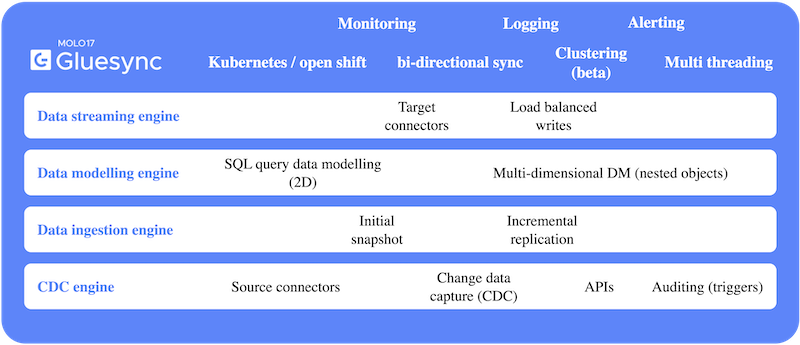
Gluesync’s architecture is built on a powerful multi-layered system of specialized agents, each handling specific aspects of the data integration process.
Core Components
CDC Engine (Source Connector)
Purpose: Manages the "first mile" connection between data sources and the ingestion engine.
Key Features:
Feature
Description
Security
* Native TLS support
* Vendor-certified JDBC drivers
* Official SDK implementations
Connectivity
* JDBC for relational databases
* Native SDKs for NoSQL/data lakes
* Auto-recovery for connection losses
Consistency
Part of Gluesync’s two-phase commit system
We exclusively use vendor-issued drivers and SDKs - no custom implementations.
Data Streaming Engine (Target Connector)
Purpose: Handles the "last mile" delivery of data to target systems.
Key Features:
Feature
Description
Performance
* Load balancing across nodes
* Optimized write buffers
* Multi-node cluster support
Reliability
* Auto-recovery mechanisms
* Connection loss handling
* Transaction consistency
The streaming engine optimizes performance while maintaining data integrity.
Data Ingestion Engine
Purpose: Real-time data processing and transaction management.
Key Responsibilities:
Task
Description
Load Distribution
Multi-threaded processing of data feeds
State Management
Maintains the "Gluesync state preservation table"
Mode Selection
Determines between full snapshot or change capture
The engine focuses on data flow without introspecting content, ensuring efficient processing.
Data Modeling Engine
Purpose: Real-time data transformation and mapping.
Key Features:
Feature
Description
In-Memory Processing
All transformations happen in RAM
Schema Management
Maps source structures to target requirements
Data Conversion
Handles format transformations while preserving data integrity
Maintains data security by not introspecting content
Preserves encrypted and binary data integrity
Functions like a real-time ETL processor
Security Considerations
All connections use vendor-certified security implementations
Data integrity is maintained throughout the pipeline
Encryption is preserved end-to-end
For specific driver versions and SDK details, contact our support team.