Enterprise Support
Get enterprise-level support for Gluesync through our dedicated support portal. Available 24/7 for all enterprise customers.
Accessing the Support Portal
Portal URL |
|
Availability |
24/7 access |
Authentication |
Personal credentials required |
| Don’t have access yet? You can self-register on the support portal by pressing here: support.molo17.com. |
Supported version policies
Gluesync follows a four-part semantic versioning scheme. Each segment carries a specific meaning that helps you understand the scope of a release and plan upgrades accordingly.
Versioning scheme
A Gluesync version number has the form a.b.c.d (for example, 2.0.11.6):
| Segment | Meaning |
|---|---|
|
Product identification convention. It distinguishes between Gluesync 1.x (CLI-only, no GUI) and Gluesync 2.x (cloud-native platform with GUI). A change in this number reflects significant architectural differences, making the two products distinct. |
|
Major release. Usually released every 6-8 months. May introduce new capabilities and, where unavoidable, breaking changes that require migration steps. |
|
Feature release. Adds new functionality with no breaking changes. Usually released every 2 weeks. |
|
Hotfix release. Contains fixes and patches. Usually released daily. |
End of Fix and End of Support
Each version of Gluesync is governed by a lifecycle policy that defines how long it receives fixes and support:
| Milestone | Meaning | Timing (from release) |
|---|---|---|
End of Fix (EoF) |
No further fixes or patches are produced for the version. Users must update to the next version, which is automatic and covered by the subscription. |
1 year |
End of Support (EoS) |
No further fixes or product support are provided for the version. |
2 years (1 year after EoF) |
After End of Fix, only critical security fixes may be considered under a special agreement. After End of Support, no further fixes or product support will be provided.
For extended support options beyond the standard lifecycle, contact sales@molo17.com to discuss your needs.
Example: Gluesync 1.5
As a reference, Gluesync 1.5 reached End of Fix on 2025-12-31 and will reach End of Support on 2026-12-31, in line with the policy above.
Gluesync 2.0 lifecycle
Gluesync 2.0.0 was released on September 18, 2024. Applying the standard lifecycle policy:
| Milestone | Date |
|---|---|
Release |
September 18, 2024 |
End of Fix (EoF) |
September 18, 2025 |
End of Support (EoS) |
September 18, 2026 |
The last patch release for the 2.0 line was 2.0.11.10 on June 27, 2025. As of the End of Fix date (September 18, 2025), no further fixes or patches are produced for any 2.0.x version. Users must update to Gluesync 2.1, which is automatic and covered by the subscription.
Until End of Support (September 18, 2026), product support is still available for 2.0 deployments, but only critical security fixes may be considered under a special agreement. After that date, no further fixes or product support will be provided.
| To learn what’s new in your current version, refer to the What’s New in 2.0 page. |
| While there are currently no plans for a Gluesync 3.x, the same lifecycle policy would apply to any future major version. |
Creating Support Tickets
Step 1: Product Selection
|
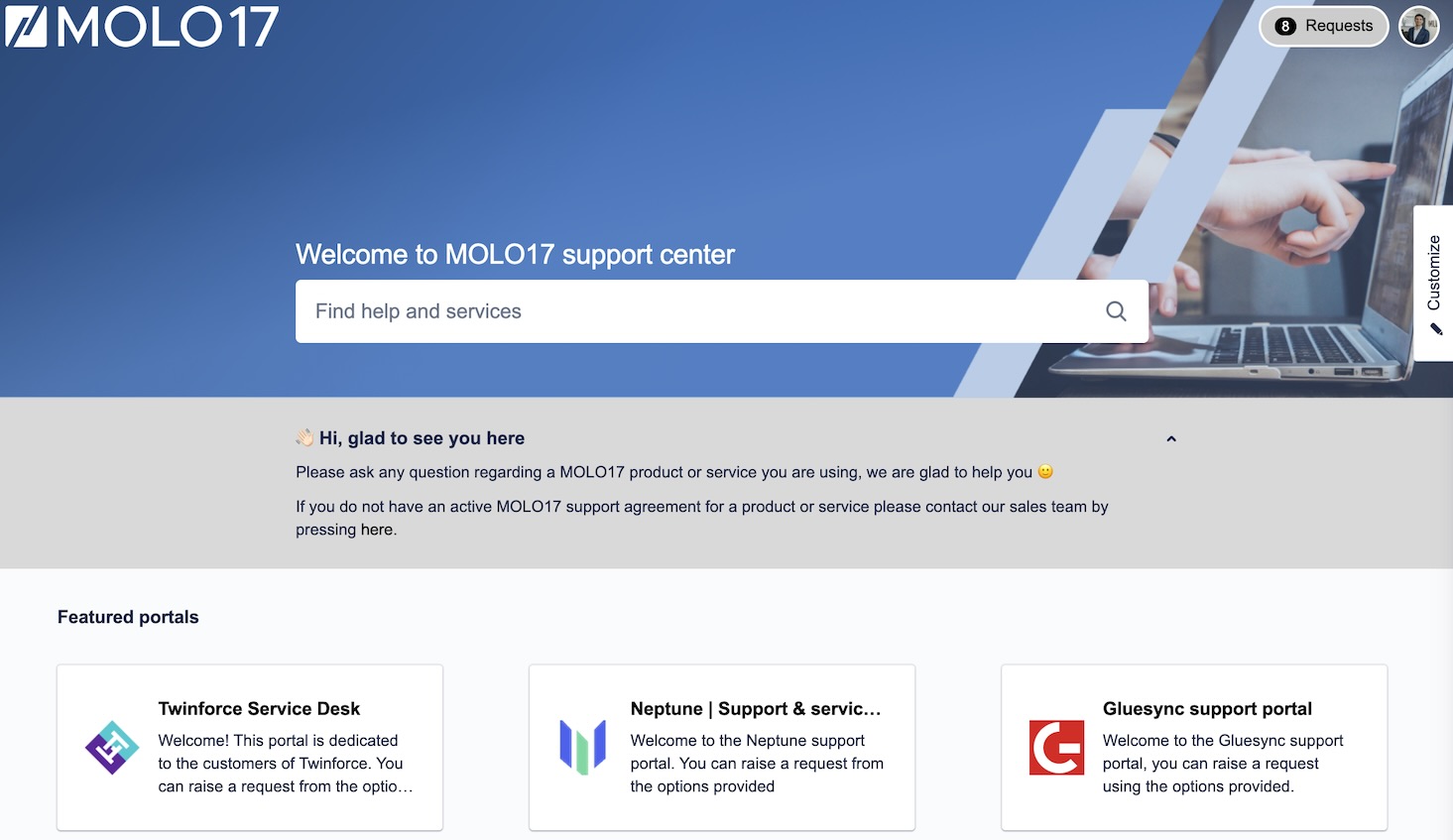
Select "Gluesync" from the available products menu to ensure your ticket is routed to the correct support team. |
Step 2: Issue Classification
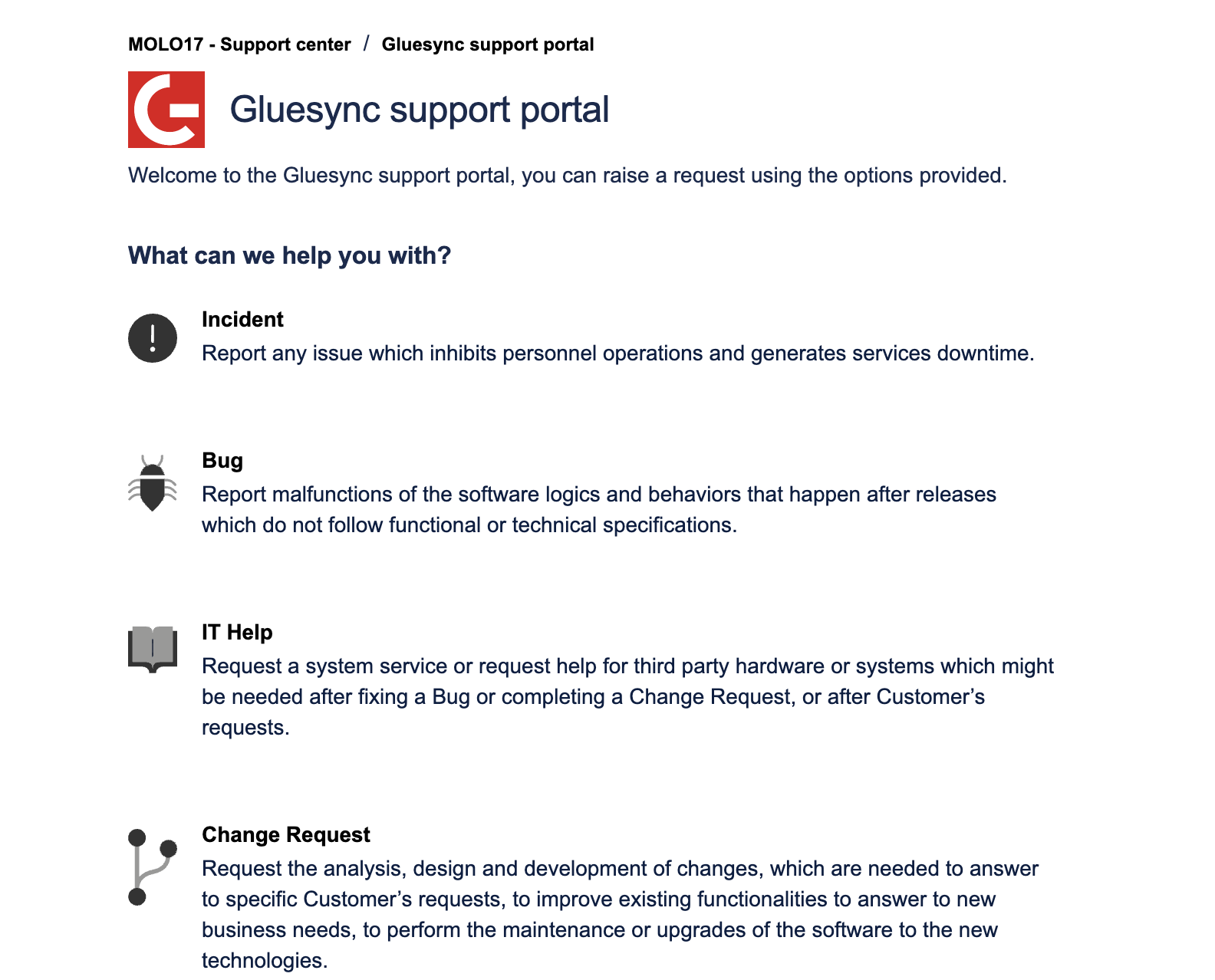
| Issue Type | Description | SLA Priority |
|---|---|---|
Incident |
Production system issues affecting service |
* P1: Critical - Service down/unusable * P2: High - Severely impaired * P3: Medium - Partially impaired |
Bug |
Software defects or unexpected behavior |
Based on impact assessment |
IT Help |
Technical assistance and configuration support |
Standard response time |
Change Request |
Feature enhancements or modifications |
Planned implementation |
|
When submitting an incident:
|